Whenever a spill occurs, keep things in order (reminder for children) and store food in sealed containers.
As with all pest control, be sure to take out the garbage regularly and if you have compost containers, be aware of any unwanted visitors who come to enjoy the feast. For those with pets, cleaning your friend’s food container every night will help prevent them from sharing their dinner with crawling bugs, and be aware of what they play with on the kitchen floor. The best remedy for a problem is always to go to the source, in this case, the cockroach nest. So put on your detective hat and follow the trail of any cockroach you find. They tend to congregate in cracks in walls, skirting boards or inside pantries, as well as under mobile appliances. Cardboard boxes are also responsible for bringing cockroaches into the house without us realizing it, especially if they have been stored in garages or sheds. It is advisable to place some bait as soon as possible in case you cannot transfer all the contents to plastic boxes.
The first step in insect control is to know what type of pest you are dealing with. Each species of domestic cockroach prefers a different area in a residence, so identifying the type of cockroach is important for better control. A cockroach infestation has individuals of different sizes, including adult cockroaches with wings (usually) that reproduce and immature cockroaches without wings. Immature and adult cockroaches, unlike other insects, such as butterflies, live in the same habitat and eat the same foods.
Immature cockroaches, known as nymphs, are smaller than adults, and the young emerge from capsules deposited by the adult female. As the nymph grows, it sheds its “skin” or exoskeleton so it can grow larger. Each nymphal stage is larger than the previous one, and an adult emerges after the last nymphal stage. Life cycle (egg, nymph, and adult) of the German cockroach. The German cockroach has at least six. Each species of cockroach has a unique number of immature stages.
All stages can be identified, but the characteristics of the adults are larger and more distinct, so let’s focus on identifying the adults.
Head: In the head, cockroaches have mouthparts that are used for chewing or scraping food that is too large for the cockroach to swallow whole. Cockroaches have a pair of compound eyes, but have poor vision except that they can easily distinguish between light and dark. You have probably noticed that these pests are nocturnal (active at night and hidden during the day) because they are repelled by light. The other structure in the head is a pair of long, well-developed antennae, their sensory organs that they use to detect odors and vibrations in the air. Inside the head, they have a small brain that coordinates the varied functions of the body.
Thorax: In the thorax, all cockroaches have three pairs of legs. Adults in most domestic species have two pairs of wings, although one species, the oriental cockroach, has poorly developed wings in both sexes. Even winged species are bad at flying, but have excellent running skills. Many species of cockroaches can defy the law of gravity and cross walls or ceilings.
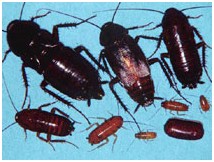
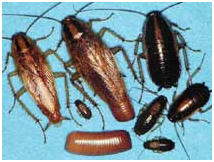
They have a large structure on the thorax in the shape of a plate, just behind the head. This structure, the pronotum, has color patterns that distinguish some species of cockroaches, so it is an anatomical feature.Abdomen. The cockroach’s abdomen houses the reproductive system. The eggs are enclosed in a hard capsule that protects them from drying out. The female of one species, the German cockroach, carries the capsule with her until the eggs are almost ready to hatch. See Table 1 to find out where the eggs of each species can commonly be found. Cockroaches do not exhibit paternal care and can be cannibalistic, as they eat their offspring if there is no food available. They also eat injured and dead cockroaches.
Abdomen: At the end of the abdomen, there is a pair of cerci, which are projections that serve as sensory organs. The cerci function similarly to antennae, detecting vibrations through the air or ground. The cerci are directly connected to the cockroach’s legs by ganglia in the abdominal nerves (like a second brain), which is an important adaptation for survival. When the cockroach “feels” a presence with its cerci, its legs start running even before the brain receives a signal. Once a cockroach starts running, you have to be pretty quick to catch it.
|
Species of Cockroach
|
Length |
Color and Markings
|
Eggs
|
From Egg to Adult
|
Reproductive Characteristics
|
| German cockroach (Blattella germanica) |
9/16 of an inch (14 mm)
|
light brown with two dark stripes on the pronotum
|
37
|
55–68
days
|
the female carries the capsule for about 24 hours before they emerge, and then places them in an isolated location.
|
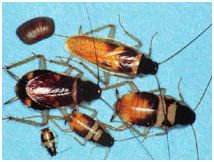
| Brown-Banded Cockroach (Supella longipalpa) |
9/16 of an inch (14 mm).
|
Golden-brown in color with lighter stripes in a V-shape on the wings
|
16
|
95–276
days
|
The egg capsule is placed under the surface of objects, cabinets, and furniture crevices.
|
| Oriental Cockroach (Blatta orientalis) |
1 – 1-1/4 inches (32 mm),
|
dark reddish-brown to black
|
14
|
300–800
days
|
The egg capsule is deposited in a safe location such as in waste or food.
|
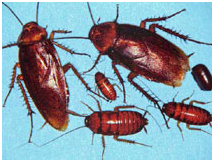
| American Cockroach (Periplaneta americana) |
1-1/2 inches (38 mm)
|
long, brown in color with a light-colored border along the edge of the pronotum. It is a very large cockroach.
|
14
|
285–616
days
|
The female carries the egg capsule for up to six days before depositing it in a safe location.
|
Table 1
Identify Your Cockroaches.
-
-
Oriental Cockroach
-
-
German-Cockroach
-
-
Brown-Banded Cockroach
-
Can I Control Cockroaches Myself?
You may be wondering, “Can I try to control cockroaches in my home myself, or do I need an exterminator?” Hiring a pest control service can be helpful as part of your cockroach control program, especially if you have a severe infestation and/or don’t want to handle insecticides. Safe use of insecticides also requires appropriate protective clothing and may require some specialized equipment.
The main advantage of doing it yourself is cost savings. Another advantage is that you know your home better than a stranger. For example, you know where the cockroach hiding areas are, and, since you are there more often, you can better track progress and evaluate control efforts. In addition, insecticide treatments are only one aspect of cockroach control, and pest control companies may not emphasize other important tactics needed for effective control.
Did you know that most insecticides registered for cockroach control are general-use insecticides? General-use insecticides can be used without special training, although it is still important to read and follow label instructions. Some manufacturers have labeled their cockroach control insecticides “for use only by certified technicians,” which means you cannot use them unless you have taken training and passed an exam to obtain state licensing to use them. Most products for professional use are marketed to pest control professionals, so these products are not found in supermarkets, hardware stores, or discount stores where you may first try to buy them. But, there are very effective products – some even identical to those sold to professionals – that you may be able to find locally.
Whether you want to do it yourself or hire a professional, you need to know which products are most effective and how to use them safely and effectively.
Multiple Tactics Method:
Since cockroaches adapt very quickly, the most effective type of cockroach control involves using multiple methods at the same time to reduce cockroach populations. Agricultural pest control specialists have been using this method for years. This multi-tactic method is called Integrated Pest Management (IPM).
The basic components of IPM are:
- Identifying the pest.
- Understanding the biology and behavior of the pest.
- Determining if control is needed.
- Identifying all control measures that are appropriate according to the specific situation, including non-chemical or chemical measures.
- Implementing safe and effective control tactics.
- Evaluating control efforts.
When managing cockroaches, this IPM method includes first observing areas where infestations are suspected to find the pest species and know where the infestation is located before treatments are applied. Then, it would be good for you to observe the same areas to see how successful your control program has been. Preventing entry by using good sanitation practices, sealing cracks and crevices, placing baits carefully, and using low-toxicity insect growth regulators with insecticides are tactics that will bring the cockroach problem under control.
Regardless of whether you decide to do it yourself or hire a pest control company to help you with insecticide applications, this manual will present the basic control tactics needed to eliminate cockroaches in your home. If all control tactics are used, significant reductions in a cockroach population can be achieved. Complete elimination is possible.


 Leafcutter ants, also known as zompopa ants, are a unique species found in the Americas, particularly in Central and South America, as well as certain areas in the southern United States. These ants are especially known for their ability to cultivate their own food, which sets them apart from most ants that we know of.
 Identify the colony: the first thing you should do is identify the zompopa ant colony that is causing problems on your property. This can be difficult, as these ants build their colonies underground and can spread over several meters. However, if you find a mound of earth or a hole in the ground, it may be a good indicator of the presence of a colony.
 eggs per day, making her an impressive reproductive machine.